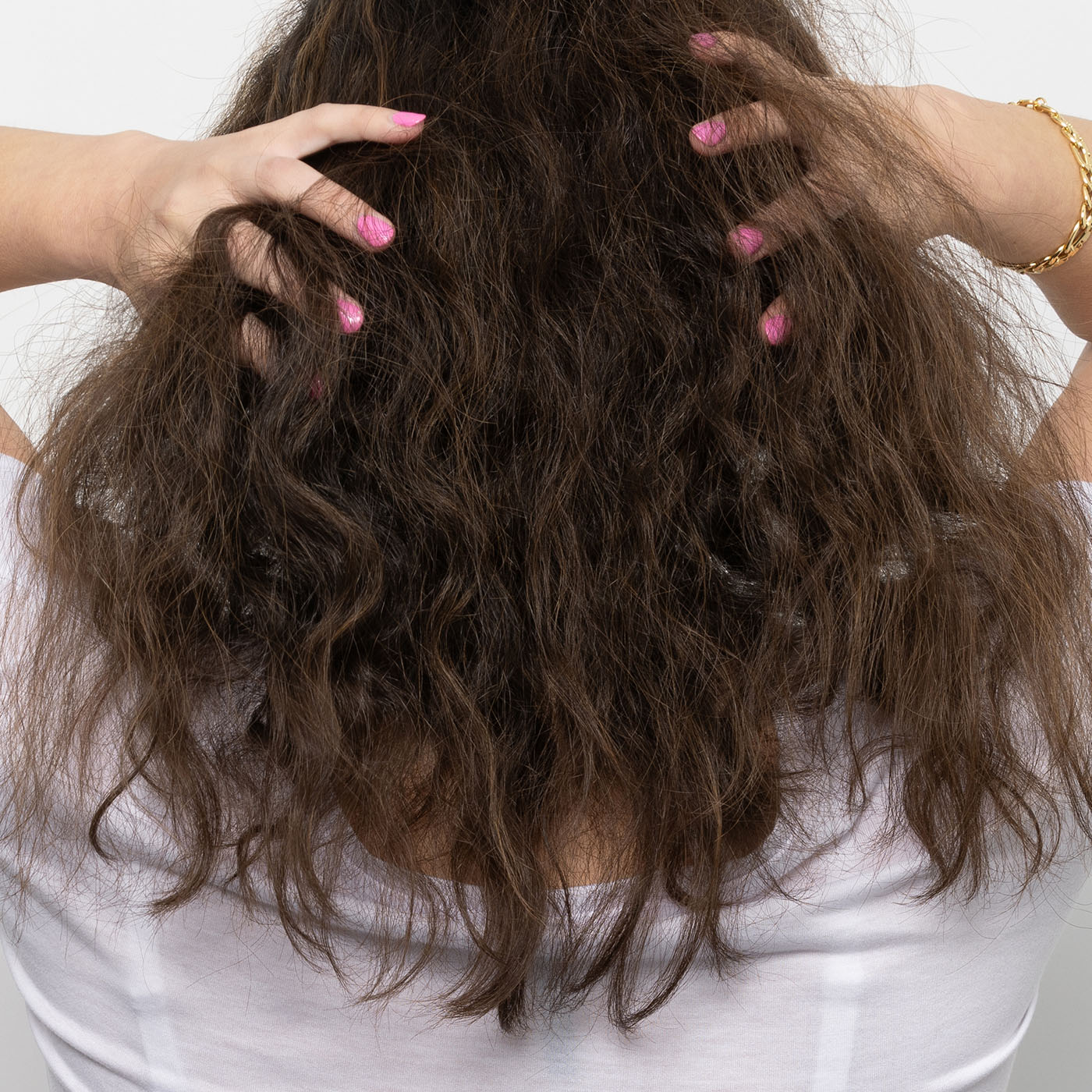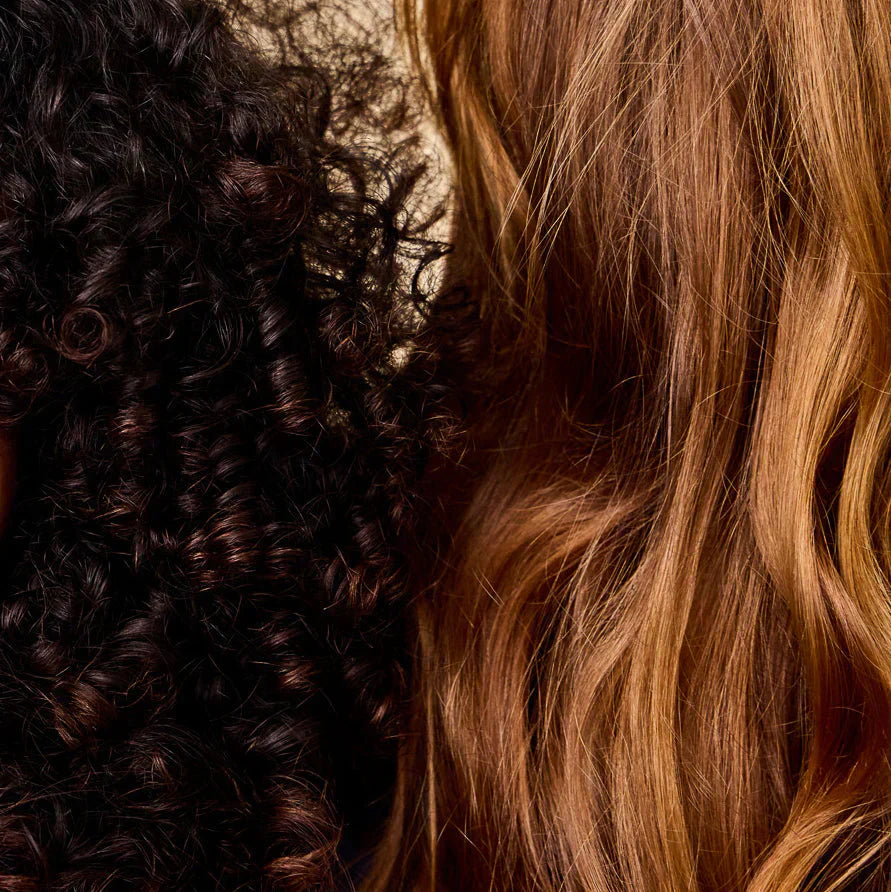

Damaged hair loses its ability to hold moisture, reflect light and resist breakage. You can spot it by running your fingers along a strand - healthy hair feels smooth from root to tip, while damaged hair catches and snags where the cuticle has lifted or worn away. Split ends, a rough or straw-like texture, excessive tangling and hair that snaps when you stretch it are all reliable indicators. Some damage is visible in a bathroom mirror. Other signs only show up when you run a few simple tests.
This guide is about diagnosis - figuring out what is going on with your hair before you reach for a product or book a salon appointment. If you already know your hair is damaged and want solutions, we have guides on how to stop hair breakage and how to revive damaged hair after summer. But diagnosis comes first. Treat the wrong problem and you waste time, money and patience.
What happens to hair when it gets damaged
A single strand of hair has three layers. The medulla sits at the centre (not every hair type has one). The cortex surrounds it - this is the bulk of the strand, full of keratin proteins and the pigment that gives hair its colour. And wrapping around everything is the cuticle, a layer of overlapping cells that looks a bit like roof tiles under a microscope.
When hair is healthy, those cuticle tiles lie flat. They keep moisture in and reflect light, which is why undamaged hair tends to look shiny. Damage lifts and chips away at those tiles. Sometimes it strips them off entirely, exposing the cortex underneath. Once the cortex is exposed, protein and moisture leak out. The hair shaft weakens. Brittleness follows.
Worth noting: damage is cumulative. Each round of heat styling, UV exposure or chemical treatment chips away a little more. A 2016 study in *Skin Research and Technology* (Lee et al.) developed a twelve-point grading system to measure subtle cuticle surface changes - even damage that looks minor under normal light shows significant structural disruption under scanning electron microscopy. Hair does not repair itself the way skin does - once a cuticle cell is gone, it is gone. New growth from the root starts fresh, but existing strands only get more compromised over time.
Visual signs you can spot right now
Some damage announces itself. You do not need a lab for this part.
Split ends are the most familiar sign. Pick up a strand and look at the tip. Healthy ends taper to a single point. Damaged ends split into two, sometimes three or more branches - like a fraying rope. If you notice splits creeping up the hair shaft (not just at the very tip), that is more advanced damage. Regular trims help prevent splits from travelling further, but they are not a diagnosis in themselves. They are a symptom.
Dull, flat colour is another giveaway. Damaged cuticles scatter light in every direction instead of reflecting it uniformly. Think about the difference between a polished wooden floor and one that has been scuffed up. Same material. Completely different surface. If your hair used to catch the light and now it just sort of absorbs it, the cuticle layer is likely compromised.
Then there is thinning at the ends. Run your fingers through your ponytail or gather your hair at the nape of your neck. Does it feel noticeably thinner at the bottom compared to the roots? Breakage along the hair shaft creates this tapered effect. Different from natural shedding, where you lose the entire strand from root to tip.
What damaged hair feels like
Close your eyes. Seriously. Slide a strand between your thumb and index finger from root to end. Healthy hair feels like a ribbon of silk - continuous, consistent, smooth. Damaged hair has rough patches, bumps, or a scratchy quality. Some people describe it as feeling like dried-out straw. Others say it reminds them of cotton - fluffy and insubstantial where it should feel solid.
Dry hair and damaged hair overlap but they are not identical. Dry hair lacks moisture. Damaged hair has structural compromise to the cuticle or cortex. You can have dry hair that is not damaged (just thirsty). You can also have damaged hair that does not feel particularly dry yet - especially if you are masking the damage with heavy conditioners or silicone-based products that coat the outside of the strand. Our guide on why hair gets dry covers the moisture side in more detail.
Brittle hair snaps. If your hair breaks off when you brush it, comb through it or even just pull it into a ponytail, that brittleness signals structural damage to the cortex. Not just surface-level cuticle roughness.
Three at-home tests that tell you more than a mirror
Mirrors show you surface-level clues. These tests dig a little deeper.
The strand stretch test
Pluck a single clean strand. Hold it between both hands and gently stretch. Healthy hair with good elasticity will stretch up to a third of its length and bounce back. Damaged hair either snaps immediately (severe protein loss) or stretches without returning to its original length, like a worn-out elastic band. If it stretches and stays stretched, the internal bonds have broken down. If it just snaps with no give at all, the hair is extremely brittle - likely from too much protein or repeated chemical treatments.
The water drop test
Place a single clean strand on the surface of a glass of room-temperature water. Wait two to four minutes. Hair that floats has low porosity - the cuticle is tightly sealed, which generally means less damage. Hair that sinks slowly sits in the mid-porosity range. Hair that drops straight to the bottom has high porosity, meaning the cuticle is lifted or missing in places and water rushes right through.
High porosity is not always from damage - some hair types are naturally more porous. But if your hair used to float and now it sinks, something has changed. For a deeper dive into porosity and what it means for your routine, check out our hair porosity guide.
The texture slide test
Pinch a strand between two fingers near the root. Slide your fingers slowly down toward the tip. Smooth all the way? Good cuticle condition. Feel bumps, roughness or a gritty quality partway down? Those are spots where the cuticle has been worn away or lifted. The further from the root the roughness starts, the more localised the damage (ends are always oldest and most exposed). If roughness begins just an inch or two from the scalp, you are looking at more widespread damage.
How different causes leave different fingerprints
Not all hair damage looks the same. The cause shapes the symptoms.
Heat damage tends to create a wiry, crunchy texture. Hair loses its natural wave or curl pattern (or, for straight hair, develops random kinks). You might notice white dots along the strand - those are points where the cortex has literally melted and re-solidified. Flat irons and blow dryers running above 180 degrees Celsius are the usual culprits.
Chemical treatments - bleach, relaxers, perms - attack the internal structure more aggressively. The cortex loses protein. Hair becomes mushy when wet, almost gummy. A review in the *International Journal of Trichology* (Gavazzoni Dias, 2015) notes that chemical processing strips the cuticle's protective lipid layer and degrades disulfide bonds in the cortex - the bonds responsible for hair's strength and elasticity. Severely damaged hair from chemical processing sometimes feels spongy, which is a sign the cortex is significantly depleted.
UV and environmental damage is subtler. UV rays degrade the lipid layer that protects the cuticle, leading to gradual dryness and colour fade (even on uncoloured hair). Pollution deposits can build up on the hair shaft and scalp, creating a film that makes hair feel heavy and look flat. This kind of damage sneaks up on you over months.
Mechanical damage comes from brushing wet hair too aggressively, tight hairstyles, rough towel-drying, cotton pillowcases. It shows up as mid-shaft breakage - little broken pieces of hair sticking up at odd angles, especially around the hairline and temples. Different from split ends, which happen at the tips.
Mild, moderate or severe - where does your hair fall
Damage is not binary. It exists on a spectrum.
Mild damage: Slightly rough cuticle, some frizz, occasional split ends. Hair still has elasticity and holds moisture reasonably well. Responds quickly to conditioning. Most people sit here without realising it - especially if they use heat tools even occasionally.
Moderate damage: Noticeable dryness, hair tangles easily, more breakage than usual, colour appears dull. The strand stretch test shows reduced elasticity. This is the stage where you start seeing hair on your brush and clothes more than you are used to. Your hair type might feel like it has changed - curls may loosen, straight hair might develop a coarser texture.
Severely damaged hair: The strand snaps during the stretch test. Hair feels like straw or, at the other extreme, goes limp and mushy when wet. Porosity is very high. Products seem to disappear into the hair without doing much. At this stage, the cuticle is largely gone in the most affected areas and the cortex is exposed. Cutting away the most damaged sections is often the most effective path forward, paired with gentle care for new growth.
When damage needs more than a diagnosis
Identifying the damage is the first step. Once you know what you are dealing with, you can respond accordingly. For mild to moderate damage where the cuticle is roughened and hair is losing moisture and breaking, a protein-and-moisture approach makes the biggest difference.
Ethique's REPAIRING Shampoo and REPAIRING Conditioner are formulated with rice protein, mango seed butter and shea butter - rice protein helps patch gaps in the damaged cuticle while the butters replenish lost lipids. Used together as a system, the REPAIRING Duo reduces breakage by 5x after just one use.* The full damaged hair collection is worth a look if you want to compare options for your hair type.
*Clinical testing. Results when REPAIRING Shampoo and Conditioner are used as a system.

If your damage shows up more as thinning and weakness than dryness - hair that feels limp, snaps easily, lacks volume - Ethique's STRENGTHENING Shampoo takes a different approach. Rosemary extract, biotin, hydrolyzed quinoa and peppermint oil work to reinforce the hair shaft. Clinical testing shows 3X stronger hair after one use and a 70% reduction in breakage.*
*Clinical testing on STRENGTHENING Solid Shampoo.

Frequently asked questions
Can damaged hair become healthy again?
Existing damage to the cuticle and cortex cannot be reversed - hair is not living tissue in the way skin is. But you can dramatically improve how damaged hair looks and behaves with the right care. Protein treatments fill in gaps along the cuticle, moisture-rich formulas restore pliability, and regular trims remove the most compromised ends. New growth from the follicle is undamaged, so with patience (and less exposure to whatever caused the damage), your overall hair health improves over time.
Is my hair damaged or just dry?
Try the strand stretch test. Dry hair that is not structurally damaged will still stretch and return to its original length - it just feels rough and looks dull. Damaged hair either snaps or stretches without bouncing back. If a deep conditioning treatment makes your hair feel great for a day or two and then it reverts, you are probably dealing with damage rather than simple dryness.
Does damaged hair grow slower?
Damage does not affect the growth rate at the follicle. Hair grows from the root at roughly the same pace regardless of the condition of existing strands. What damage does affect is length retention. If your hair is breaking off at the same rate it grows, it looks like slow growth. It is not. It is breakage disguised as stalled progress.
How often should I check for damage?
Once a month or so. Run the strand stretch test and texture slide test after washing your hair (no product on it). You will notice changes in elasticity and surface texture before you see visible damage in the mirror.
Putting the diagnosis to work
Knowing what damaged hair looks like - and being honest about where yours falls on the spectrum - makes every decision after this easier. Which products to use, whether to cut, how to adjust your heat and styling habits. All of it starts with an accurate picture of where you stand right now.
Your hair is not a mystery. It is a material, and materials give you clues. Pay attention to those clues.
Sources
Lee SY, Choi AR, Baek JH, Kim HO, Shin MK, Koh JS. "Twelve-point scale grading system of scanning electron microscopic examination to investigate subtle changes in damaged hair surface." Skin Research and Technology. 2016. https://pubmed.ncbi.nlm.nih.gov/26792196/
Gavazzoni Dias MF. "Hair cosmetics: an overview." International Journal of Trichology. 2015;7(1):2-15. https://pubmed.ncbi.nlm.nih.gov/25878443/